THE GÖBEL-MIRRORS
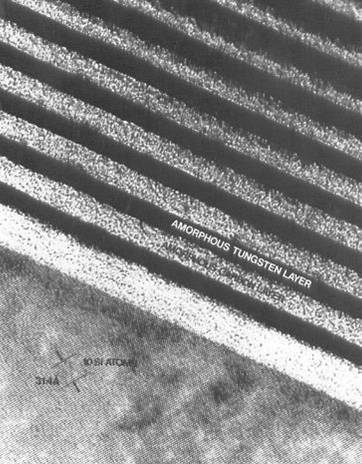
Periodic Multilayers (period around 5 nm) of a high Z-(reflector) and a low Z-(spacer)-material
show high Bragg - reflectivity for x-rays and can be tailored to any optical surface (elliptic,
parabolic, hyperbolic or flat) to achieve a focussing, parallel or divergent primary beam.
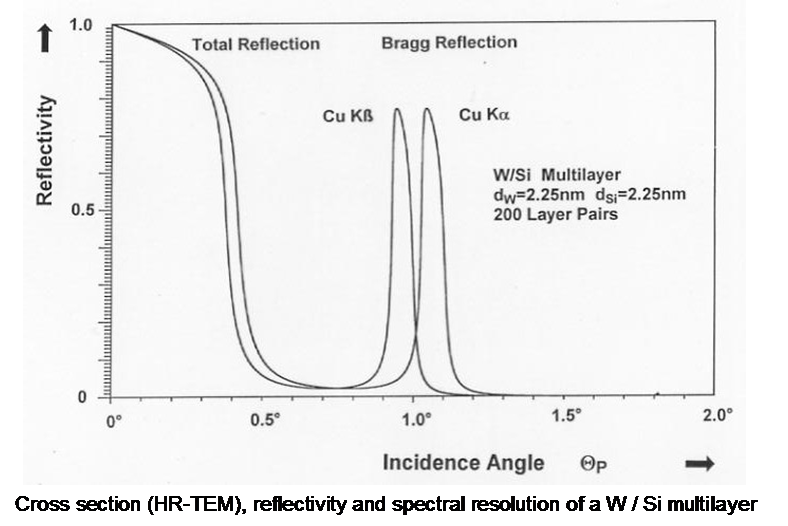
With the suitable grading of the period it is possible to satisfy Bragg’s law simultaneously
over its entire figure. The results are primary beam monochromators with about 80-90%
reflectivity, also for soft x-rays.
As appreciation of the pioneering work of Dr. Herbert Göbel in the early 1990’s they were
called "Göbel-Mirrors" to receive the Hanawalt Award 1998 (ICDD).
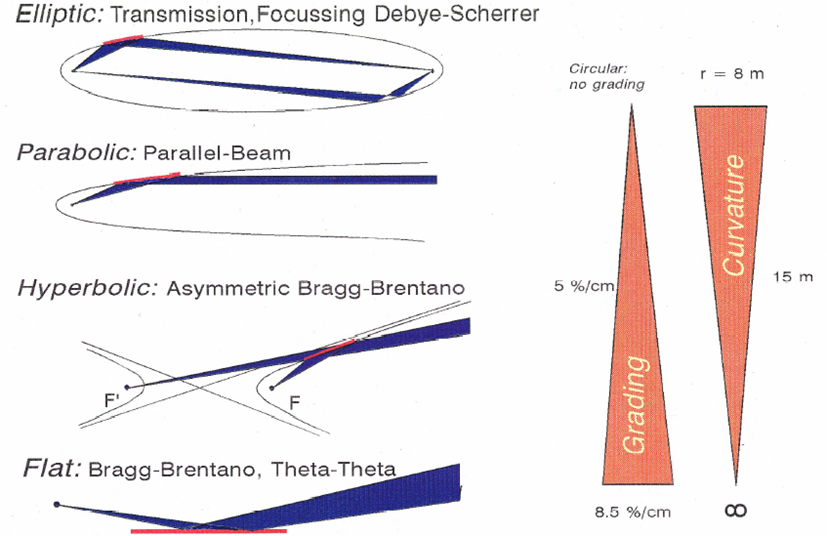
The four focussing figures of Göbel-Mirrors and their application
in different diffraction geometries
The d-gradient decreases with increasing curvature.
Typically the gradient in a flat mirror has to be twice as high as for a parabolic mirror.
LabXA is eqipped with elliptic, parabolic and flat mirrors on the respective diffraction units.
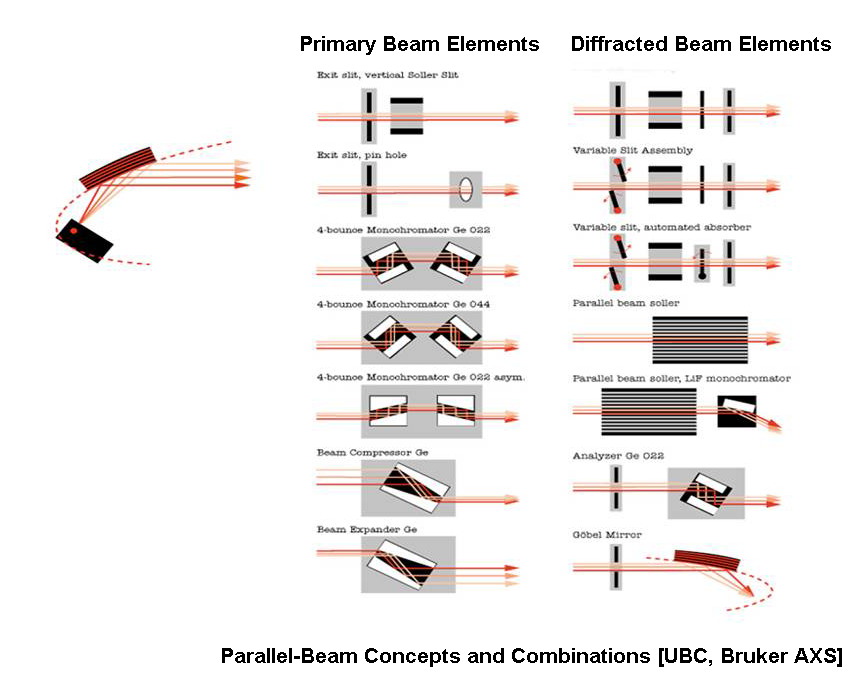
Parallel-Beam Concepts with Parabolic "Göbel-Mirrors", Channel-Cut Crystals and Collimators
Obeying practical requirements and physical principles the parallel beam optics allow a variety
of combinations of beam conditioning elements for different applications. Most important are methods
for surface and thin-film characterization that use a grazing incidence primary beam (GI-XRPD, XRR,
TRXRF) or methods that require a highly collimated and monochromatic beam (XRR, HR-XRD).
Most of the elements were tested at LabXA and the useful combinations conserved in an
interchangeable modular-design system. The above mentioned methods are described later
in our systems or in further publications. The high intensity from the parabolic mirror
increases the efficiency of some methods up to a factor of 100 and allows an easy and proper
adjustment of the systems. The channel-cut Ge(110) crystals were provided by Siemens Corp.
Technology (M. Schuster).